
Growth vs Evolution: Ticking the SEO Box
We seem to be at a significant crossroads as a species. You can feel it instinctively.
In a data-driven world, that kind of visceral response is often dismissed as primitive. But perhaps its forgotten value is close to being rediscovered, re-born and reapplied.
I no longer believe GDP is the valid measure of success it once appeared to be. In fact, that is probably generous. Any measure of success that treats endless growth and competition as fundamental, while ignoring the finite nature of the systems that support us, and the long string of success stories borne out of collaboration, begins to look less like oversight and more like wilful ignorance.
But does that make growth itself bad? Not necessarily. Like many things, it is rarely wise to throw out the conceptual baby with the systemic bath water.
The better question may be this: is growth the problem, or is our definition of growth broken?
If we stopped seeing growth as a straight line and started thinking about it in evolutionary terms, it could become a more useful compass for what comes next. Whether you apply that question to yourself, a business, a government or society, reframing what “good growth” means has real validity and genuine transformational potential.
1) Evolution Doesn’t Start with Us. So, We Need to Stop Acting Like it Does.
Evolution does not start with us. We are a continuation of billions of discoveries, adaptations and inherited decisions. Seen that way, we are also part of a future journey that someone else has not yet begun.
Approaching life or business strategy through that lens: with humility, continuity and circularity can lead to decisions rooted in wisdom, not just knowledge.
That may sound aspirational, so let’s make it practical.
When you write a five-year strategy, do you treat it as part of a thirty-year vision? Or does year five simply become someone else’s problem?
Neither approach is automatically right or wrong. But being honest about whether you are building something designed for succession, or something valuable enough to be bought, becomes much clearer when you keep the evolutionary long game in view.
A business built to be sustainable, aligned with a wider vision of the future and aware of its broader ecosystem does more than create purpose and meaning. It also creates value for whoever inherits it when your own race has been run.
2) What Football Can Teach Us About Why Winning Isn’t Always Winning
Competition is powerful; until winning becomes inevitable
Take the Premier League. When a football club builds a strong ethos and culture, aligns talent with that culture and translates it into consistent results, it can be hugely rewarding for fans, the board, players and everyone involved.
At its best, that success raises the level around it. It pushes other clubs to improve, feeds money and knowledge into grassroots football and makes the whole ecosystem stronger over time. The following season then becomes more challenging for the team at the top: a more cyclical, evolutionary version of success.
But something changes when a team gains enough influence to bend the rules, buy success or pull levers of advantage that only a handful of others can access. The victories become hollower. Purpose and vision diminish. Even the fans may start to question whether the path still reflects what competition is meant to be.
The same question applies to clubs that raise eyebrows just enough to attract attention, sell their best players to bigger teams and then rebuild again. Does that repeated strategy serve a meaningful role in the footballing ecosystem, or does it tick fewer boxes over time?
3) The Trick Hiding in The Headline
Since we are talking about games and their rules, it is worth looking at the headline that brought you here: a power word, an odd number and a bracketed promise about number four.
That is a formula, not a coincidence.
It is designed to satisfy a ranking algorithm’s idea of a good article and to scratch the itch of curiosity that earns a click. It is not necessarily designed to say something true first and be found second.
4) Why I Left It in Anyway
I could have gone back and fixed the headline once the irony became obvious.
But pretending I had fully stepped outside that logic while writing about the need to step outside that logic felt more dishonest. A bit like writing about the finite nature of our support system from a private jet.
Gaming the algorithm is the same instinct as chasing GDP: optimise for the number the system rewards, then worry later, if at all, about whether that number actually means anything.
Most of us have not evolved beyond that operating system as much as we might like to think.
5) Correction: This Bit’s About Your IT
The bracket at the top promised this would be number four. The formula looked standardised and guaranteed and yet still missed by one.
That is worth remembering the next time something promises you a fast, standardised fix for a problem that was never going to be standard or fast in the first place.
Everything explored so far is also a fairly accurate description of how most businesses are sold their technology.
The “buy its success” club is the vendor that locks you into a contract, upsells kit you do not need to hit a quarterly number and treats the relationship as something to extract from rather than build.
It produces the same hollow win. The invoice gets paid and the box gets ticked, but nothing about your business becomes stronger, more resilient or closer to what you were trying to build.
That is IT as linear growth: more spend, more seats, more throughput. Measured in the same way GDP measures a country, as if the number going up is the whole story.
The alternative is the club that raises everyone’s level over time.
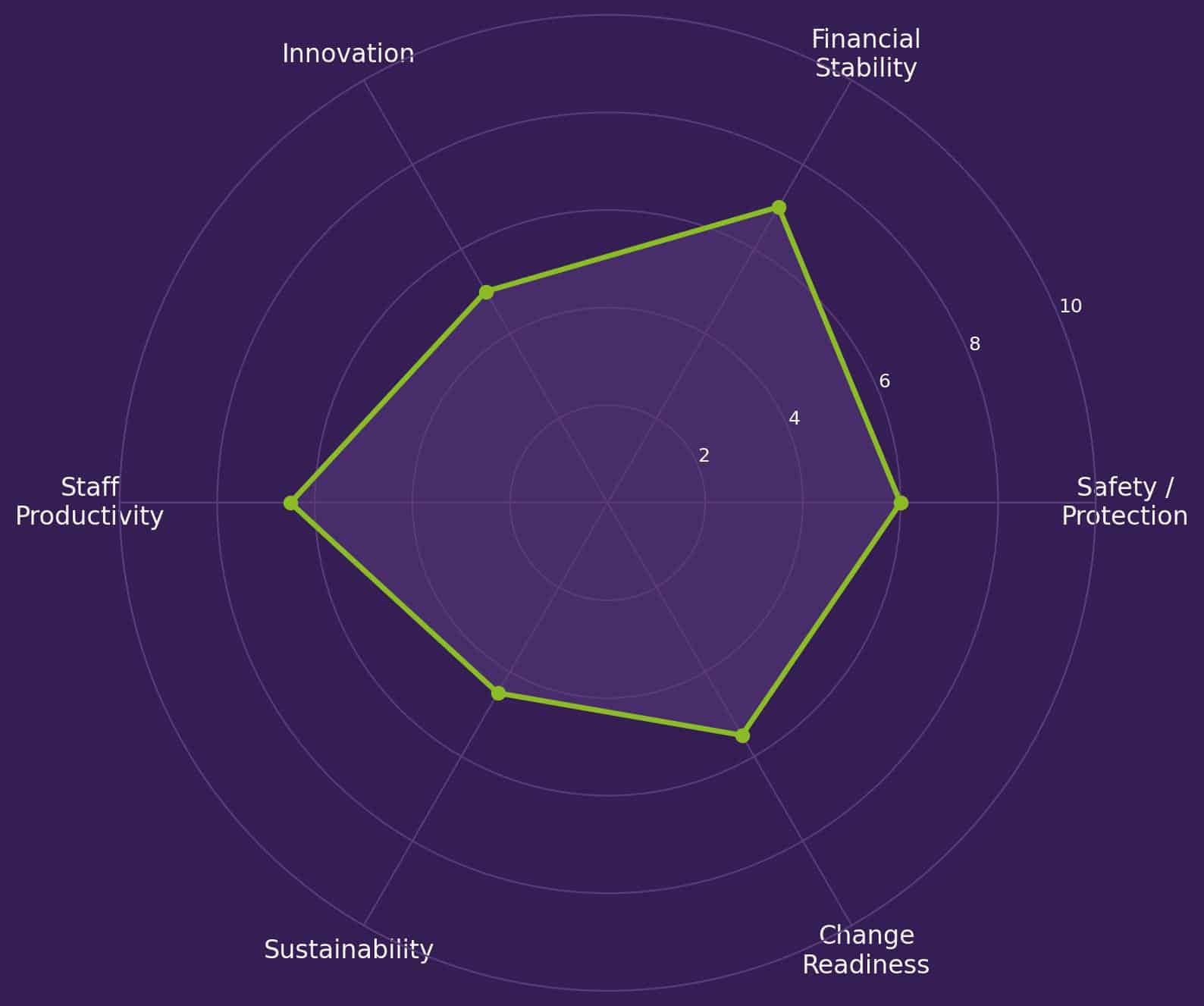
IT chosen for evolution rather than extraction looks less like a shopping list and more like a maturity journey:
- infrastructure and support that make your team more capable over time;
- systems that help people become more self-sufficient, not more dependent;
- relationships that do not need to manufacture new problems just to sell the next fix;
- progress from reactive and exposed, to steady and covered, to fluent in your own systems;
- a foundation strong enough that, eventually, you need far less handholding.
That is not just a cost line. It is the by-product of building something purpose led.
It is the same distinction the football analogy was making, only with a support contract instead of a transfer fee.
Questions Worth Sitting With
When you look at where you are now, and where you would like to be, these questions may help shift your thinking about your business generally and the technology underneath it specifically:
- Is profit the starting target, or the by-product of a wider purpose?
- Is your IT spend something to minimise, or something that earns its keep by making the rest of the business stronger?
- Am I making decisions based on my own aspiration and inner truth, or on what others, including whoever is selling me something, say “good” should look like?
- Am I building a client base and team that are genuinely happy and properly served, or one that simply stays around long enough to look good on a spreadsheet?
- How valuable are my staff to me, and does the technology I have given them make that obvious, or does it get in their way?
- When I think about growth versus sustainable growth, do I know what “enough” looks like? Could a limit to growth be just as much a sign of success as growth itself?
Nothing above needs an answer by Friday. That is rather the point.
Evolution is not a sprint towards a KPI. It is a direction you keep checking you are still facing.
If any of these questions landed somewhere honest, that is worth more than a tidy conclusion.